

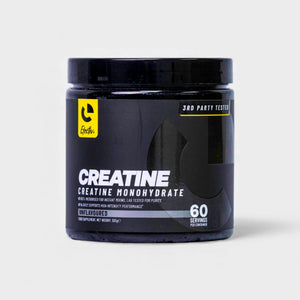

Creatine for ATHX Training - Timing, Benefits, and Best Practices
Hybrid training asks more from your body than a single-discipline programme. You need strength, power, running fitness and the ability to repeat hard efforts without falling apart. Creatine monohydrate is one of the most researched sports nutrition supplements available, and for ATHX, HYROX and hybrid athletes, its biggest value may be its ability to support repeated high-intensity work and recovery.
As a hybrid athlete, balancing the demands of strength and endurance training can be a significant challenge. You're constantly pushing your body, whether you're tackling early morning miles before work, enduring long Sunday runs, or engaging in high-intensity HYROX and ATHX sessions. This relentless pursuit of performance requires intelligent fuelling and recovery strategies.
Creatine is often associated with traditional strength training, but its potential role in hybrid training is broader. When your programme combines lifting, running, intervals and repeated high-output efforts, the ability to produce and repeat power matters. Creatine monohydrate can support that side of performance while fitting easily into a long-term sports nutrition strategy.
For ATHX and hybrid athletes, creatine is less about chasing a single bigger lift and more about supporting the high-intensity work that sits between your endurance efforts. The practical priority is simple: use creatine monohydrate consistently, stay hydrated, and treat it as part of your overall training and recovery strategy rather than a last-minute performance boost.

Understanding Creatine and Its Role in ATHX Training
For athletes serious about their training plan, especially those preparing for demanding ATHX or HYROX-style events, understanding how supplements fit into the bigger picture is important. Training quality, adequate carbohydrate intake, sufficient protein, sleep and recovery should form the foundation. Supplements should support that foundation rather than replace it.
Creatine has been a cornerstone of sports nutrition for decades because its effects on high-intensity exercise performance are well established. For a hybrid athlete, that makes it particularly interesting: you're not simply trying to build muscle or run further. You're trying to produce useful power repeatedly while still having enough endurance to keep moving.
What is Creatine?
Creatine is a naturally occurring compound involved in energy production. Most of the body's creatine is stored in skeletal muscle, where it contributes to the rapid regeneration of adenosine triphosphate, or ATP. ATP is the immediate energy currency used by muscles during exercise.
Your body produces creatine naturally and you can also obtain it from foods such as red meat and fish. Supplementing with creatine monohydrate is a practical way to increase muscle creatine stores beyond what can typically be achieved through food alone.
Power is useful when the workout keeps changing.
Strength work → running → stations → intervals → repeat. ATHX-style training demands the ability to produce and reproduce high-intensity efforts rather than relying on one energy system alone.
Benefits of Creatine Supplementation
The evidence supporting creatine supplementation is extensive, particularly around strength, power and repeated high-intensity exercise. For hybrid athletes, these benefits can have a wider application because many endurance-based events include repeated surges, hills, stations, carries, sled work or short periods of maximal effort.
1. Strength & Power
Creatine can support the ability to produce force during strength training and other high-intensity efforts.
2. Repeated Efforts
Improved phosphocreatine availability can help support repeated short-duration, high-intensity efforts with recovery between bouts.
3. Muscle Preservation
Adequate creatine intake alongside sufficient protein and energy can support the maintenance of lean tissue during demanding training.
4. Training Quality
Better capacity for high-intensity work can help you maintain quality across the strength and conditioning sessions in a hybrid programme.
Creatine is not primarily a marathon-pace supplement. Its value for a hybrid athlete comes from supporting the high-intensity components around your endurance work: strength sessions, hills, intervals, carries, sled work, stations and hard finishing efforts.
Why Take Creatine for Hybrid Training?
For a hybrid athlete balancing the demands of ATHX or HYROX training, creatine offers a multifaceted approach to performance support. It isn't simply about lifting heavier. It's about sustaining the quality of varied work when your training repeatedly asks you to change pace, produce force and recover quickly.
Creatine can increase your capacity for high-intensity work, supporting power output during strength training and repeated hard efforts during conditioning. Over time, being able to train consistently and maintain quality across sessions is one of the most useful outcomes of a well-structured supplement strategy.

Timing of Creatine Supplementation
Creatine timing is much less complicated than it is sometimes made to sound. The most important factor is regular daily intake. Once muscle creatine stores are elevated, there is no need to chase a narrow pre-workout window.
When to Take Creatine Around Exercise
For athletes preparing for demanding ATHX sessions, the question of when to take creatine naturally comes up. The practical answer is that daily consistency matters most. Creatine works by gradually increasing and maintaining muscle creatine stores, so missing doses is generally more important than whether you take it at 8am or 8pm.
If taking creatine around training helps you remember it, use that routine. Taking it alongside a meal, recovery shake or post-workout nutrition can be an easy way to make supplementation habitual.
Post-Workout: Maximising Recovery with Creatine
Many athletes prefer to take creatine after training, particularly when it is convenient to combine it with carbohydrate and protein. Following a demanding session, a recovery meal or shake can provide the nutrients needed to replenish glycogen, support muscle protein synthesis and begin the recovery process.
Adding creatine to that routine can make supplementation simple and consistent. The key is not that post-workout creatine suddenly creates a large acute recovery effect, but that it contributes to maintaining elevated muscle creatine stores over time.
A. Pre-workout
Useful if it is the easiest time for you to remember your daily dose. The benefit comes from consistent supplementation rather than an immediate stimulant-like effect.
B. Post-workout
Convenient alongside your normal protein and carbohydrate recovery nutrition. A simple routine can make daily adherence easier.
Pre-Workout Considerations for Creatine Use
Some hybrid athletes prefer taking creatine before training because it fits naturally into their pre-workout routine. That is completely reasonable, provided the daily intake remains consistent.
Unlike caffeine, creatine should not be viewed as a supplement that needs to be timed immediately before training to create an acute performance effect. Its primary purpose is to maintain elevated muscle creatine stores. Carbohydrates, caffeine where appropriate, hydration and overall fuelling can play more immediate roles in preparing for a demanding session.
If pre-workout helps you remember it, take it pre-workout. If post-workout fits your routine better, take it afterwards. The best timing is the timing you can consistently stick to.

Creating an Effective Training Programme with Creatine
Creatine should sit inside a structured training programme rather than operate independently from it. For hybrid athletes, that means considering how your supplement routine supports strength development, running performance, conditioning and recovery across the entire week.
A well-structured programme combined with appropriate creatine supplementation can support the high-intensity side of ATHX preparation while allowing you to continue developing your endurance base.
Integrating Creatine into Your ATHX Training Plan
To make creatine useful for hybrid training, integrate it into your normal daily routine rather than treating it as something you only use on hard gym days.
A hybrid programme may include heavy strength sessions, running intervals, easy aerobic work, long runs, mixed-modal conditioning and race-specific sessions. Because creatine stores are maintained through regular intake, there is little reason to cycle your daily dose according to whether a particular day involves lifting or running.
Creatine Across Different ATHX Sessions
Where creatine fits: Supports high-intensity force and power work
Primary consideration: Progressive overload and adequate recovery remain the priority
Where creatine fits: Supports repeated high-intensity efforts
Primary consideration: Carbohydrate availability is still important for quality sessions
Where creatine fits: Useful as part of the overall daily supplement routine
Primary consideration: Creatine is not a replacement for carbohydrate fuelling
Where creatine fits: Relevant to repeated high-output work
Primary consideration: Practise race-specific fuelling and pacing alongside supplementation
Where creatine fits: Continue daily supplementation
Primary consideration: Maintaining muscle stores matters more than matching intake to training
Common Mistakes in Creatine Supplementation
Creatine is straightforward, but athletes can still make the process unnecessarily complicated. The biggest mistakes usually involve inconsistent intake, unrealistic expectations or overlooking the fundamentals of hydration and nutrition.
1. Inconsistent intake
Taking creatine only before particularly hard sessions misses the point of maintaining elevated muscle creatine stores. Daily consistency is the more useful strategy.
2. Ignoring hydration
Creatine increases water stored within muscle. Staying appropriately hydrated is therefore an important part of any demanding hybrid training programme.
3. Expecting instant results
Creatine is not a pre-workout stimulant. Its benefits develop as muscle creatine stores increase and remain elevated.
4. Overcomplicating the dose
For most athletes, a simple daily 3–5g creatine monohydrate routine is easier to follow than an unnecessarily complicated protocol.
Consistency beats complexity.
Your supplement strategy should make your training easier, not become another performance variable you have to obsess over.
Adjusting for Rest Days and Race-Day Needs
Creatine on Rest Days
Rest days are still part of the training process. Continuing your normal daily creatine intake helps maintain muscle creatine stores while your body recovers from the workload of previous sessions.
There is no need to reduce your creatine dose simply because you're not training that day. The objective is to maintain the elevated stores that support future high-intensity work.
Creatine on Race Day
Race day requires a slightly different mindset. Creatine is not a last-minute performance booster, so taking a large dose immediately before an ATHX or endurance event is unlikely to provide the same type of acute effect associated with race-day fuelling or caffeine.
Instead, think about creatine as part of the weeks and months of preparation leading into competition. If you've been supplementing consistently, your muscle creatine stores are already elevated when race day arrives.
Don't experiment with a new creatine protocol on race morning. Keep your nutrition and supplementation routine familiar, prioritise hydration and carbohydrate fuelling, and let your training do the work.

Preparing for the ATHX Games
Preparing for the ATHX Games requires more than simply adding a supplement. Your performance will ultimately depend on the combination of training quality, recovery, nutrition, sleep, pacing and race-specific preparation.
Creatine can sit comfortably within that strategy by supporting the high-intensity side of your training. Maintaining adequate creatine stores may help you repeatedly produce power during strength and conditioning work, allowing the supplement to complement rather than compete with the rest of your sports nutrition plan.
1. Train specifically
Build sessions that reflect the demands of the event, including transitions between running, strength and high-intensity stations.
2. Fuel the work
Carbohydrates remain a major fuel source for demanding hybrid training. Creatine complements your fuelling strategy rather than replacing it.
3. Recover properly
Adequate protein, carbohydrate, fluids, sleep and sensible training load management all contribute to your ability to adapt.
4. Stay consistent
The same principle applies to creatine: a simple routine followed consistently is more useful than constantly changing your approach.
Make creatine part of your everyday routine.
For hybrid athletes, the simplest supplement strategy is often the one that actually gets followed. A high-quality creatine monohydrate can slot easily into your daily nutrition, whether you're lifting, running, conditioning or recovering.
FAQs About Creatine and ATHX Training
Creatine is simple to use, but hybrid athletes often have questions about how it fits alongside endurance training, race preparation and recovery. Here are the practical answers.
How does creatine support endurance training? +
How much creatine should an ATHX athlete take? +
Do I need to take creatine before training? +
Should I take creatine on rest days? +
Can I take creatine with protein and carbohydrates? +
Will creatine make me heavier? +
Is creatine useful for HYROX and ATHX? +
What is the best type of creatine? +
Best Practices for Creatine Use
The best creatine strategy is remarkably simple. Build it into your existing nutrition routine and focus on the fundamentals rather than constantly changing protocols.
The Bottom Line for Hybrid Athletes
Creatine is one of the more straightforward supplements to consider when your training combines strength, running and repeated high-intensity work. Its strongest benefits are associated with strength, power and repeated efforts rather than directly improving long-distance endurance performance.
For ATHX and HYROX athletes, however, that distinction matters less than it might for a pure endurance runner. Your performance depends on your ability to move efficiently, produce force, run, recover and then produce force again. Supporting the high-intensity side of that equation can make creatine a useful addition to an already well-structured programme.
The winning strategy is not complicated: choose creatine monohydrate, take it consistently, stay hydrated, fuel your training properly and give the supplement enough time to do its job.
Build your ATHX training strategy smarter.
Creatine is only one part of the hybrid performance equation. Keep building your knowledge around strength, endurance, fuelling and recovery so every part of your training supports the next.


Leave a comment
This site is protected by hCaptcha and the hCaptcha Privacy Policy and Terms of Service apply.